
Marrakech: Medina Souks and Artisan Quarters Half-Day Walking Tour
- Half-Day Tour, Walking Tour, Cultural Tour, Shopping Tour
Step into the living fabric of Marrakech on a guided half-day walk through the medina’s historic souks and craft quarters. From the spice traders of Rahba Kedima to the hammering blacksmiths of Souk Haddadine, your guide brings context, calm, and access to a labyrinth that rewards those who know where to look. The route covers six distinct souk districts, closes with a traditional mint tea, and includes guidance on how to shop with real confidence.
Destination
Marrakech
Interests
Duration
3.5 hours
Transport Mode
Walking (no vehicle — all on foot within the medina)
Included
- Licensed local guide (half-day)
- Traditional mint tea
- Shopping and haggling guidance
- Medina orientation briefing
Excluded
- Hotel pickup (meeting point only)
- Personal purchases
- Tips (not required)
Thing To Do
Atlas Mountain Experiences
Not suitable for
- Wheelchair users (narrow, uneven medina lanes)
- Severe mobility limitations (cobbled surfaces throughout)
- Children under 5 (busy streets with motorbikes and carts)
Reasons to book this tour
Walk through Souk Haddadine and Souk Chouari — the blacksmiths’ and carpenters’ quarters where craftsmen still work by hand, largely unseen by most visitors.
Reach Rahba Kedima, the old spice square, and learn what to look for among the saffron, argan, and Amazigh beauty products that line its stalls.
Watch dyers at work in Souk Sebbaghine, where freshly colored wool in indigo, saffron, and vermilion hangs above the narrowest lanes in the medina.
Pause for a proper three-pour mint tea with context — what the ritual means, and what Moroccan hospitality actually looks like at street level.
Shop with real confidence: your guide covers quality markers, current price ranges, and how to negotiate without pressure or performance.
A relaxed half-day pace — six craft districts, a tea break, and free time to browse, without turning the medina into a checklist.
What you can expect
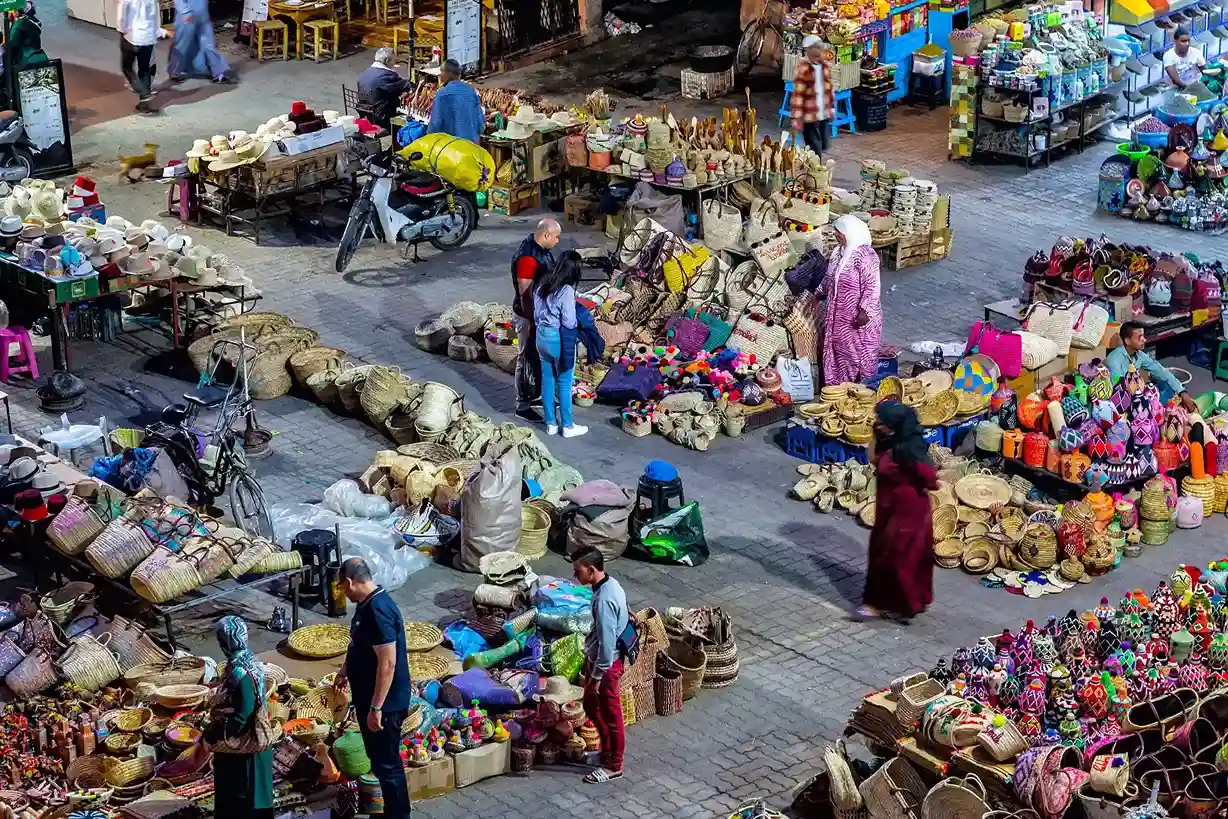
Meeting at the Threshold of the Medina
You meet your guide at Café de France on Jemaa el-Fna — the square that marks the divide between Marrakech’s modern face and its ancient interior. Before stepping into the souks, your guide gives a brief read of the day: the layout of what you’ll walk through, how the craft districts are organized, and what the morning or afternoon will feel like from here.
The entry into the souks is deliberate. You start with Souk Semmarine — the main covered artery, wide and busy — to get a sense of scale, before your guide peels off into narrower passages where the real craft life begins.
The Spice Square and the Dyers’ Lane
Rahba Kedima opens off Souk Semmarine as a small, sunlit square where elderly Amazigh women sell saffron, cumin, ras el hanout, and apothecary goods from low stalls. Your guide explains what quality saffron actually looks and smells like, and what Moroccan black soap, argan oil, and kohl are genuinely used for — not in the abstract, but as part of daily household life.
From there, the walk enters Souk Sebbaghine, the dyers’ quarter. Freshly colored skeins of wool hang above narrow passages in indigo, saffron, and vermilion red. Workers move through at ground level, hands and forearms stained from natural pigments. It’s a working space — and one of the most visually striking passages in the entire medina.
Into the Working Craft Quarters
You hear Souk Haddadine before you see it. The rhythmic sound of hammers on metal announces the blacksmiths’ quarter, where craftsmen shape iron lanterns, brass bowls, and decorative grillework by hand. These are genuine production workshops — not showrooms — and your guide navigates them with the ease of someone who knows the people working here.
Souk Chouari next door carries the scent of cedar from the carpenters’ workshops. Craftsmen cut, carve, and inlay wood using techniques that have not changed in generations. Your guide introduces these spaces with context: what’s being made, who buys it, and how long it takes to learn the craft.
Mint Tea and a Chance to Regroup
Midway through the walk, you pause for a traditional three-pour mint tea at a medina terrace or quiet café courtyard. Your guide explains the ritual — each pour has a different character, from bitter to sweetly balanced — and its place in the rhythm of Moroccan daily life. This is also a practical moment: time to rest, ask questions, and settle on what you’d still like to find before the walk continues.
The Leather Quarter and Free Time
The route closes through the leather quarter — Souk Cherratine — where tanned hides become bags, belts, babouche slippers, and poufs at a wide range of price points. Your guide walks you through what to look for in quality, what fair prices look like at the current market rate, and how to negotiate with ease rather than anxiety.
From here, you have free time: revisit a stall you spotted earlier, browse independently, or simply absorb what remains of the morning or afternoon before returning to Jemaa el-Fna at your own pace.
This is the plan
Check out the plan below to see what you’ll get up to with your local host. Feel free to personalize this offer with the host of your choice.
-
Jemaa el-Fna — Meeting and Orientation
Meeting point — Your guide meets you at Café de France on Marrakech’s central square. Before entering the souks, you get a brief orientation: how the craft districts are laid out, what you’ll walk through, and how the day’s route flows. A useful ten minutes that makes the rest of the walk land properly.
-
Souk Semmarine — The Main Artery
Guided walk — The widest covered lane in the medina: textiles, ceramics, lanterns, babouches, and general goods stacked from floor to ceiling. Your guide moves through at a steady pace, pointing out what’s genuinely well made and where to look beyond the obvious displays. A useful overview before the route narrows.
-
Rahba Kedima — The Spice Square
Local moment — A small sunlit square off Souk Semmarine where Amazigh women sell saffron, cumin, ras el hanout, and apothecary goods. Your guide explains how to identify quality saffron, what argan oil and Moroccan black soap are actually used for, and which products are worth bringing home. No pressure, no commission.
-
Souk Sebbaghine — The Dyers’ Quarter
Photo stop — Freshly dyed skeins of wool hang across the passage in indigo, saffron, and poppy red. Workers move through at ground level, hands stained from natural pigments. Your guide explains the dyeing process and the history of the textile trade in this part of the medina. One of the most visually striking passages in the city.
-
Souk Haddadine and Souk Chouari — Craft Workshops
Artisan visit — The blacksmiths’ quarter announces itself with the sound of hammers on metal: craftsmen shaping iron lanterns, brass candleholders, and decorative grillework by hand. In Souk Chouari next door, the scent of cedar leads you to the carpenters’ workshops. Your guide introduces the artisans at work — these are active production spaces, and the access feels accordingly real.
-
Mint Tea Break
Tasting — A pause at a medina terrace or courtyard café for a traditional three-pour mint tea. Your guide explains the ritual and what it signals in Moroccan daily life. A natural mid-point to rest, ask questions, and settle on what you’d like to find in the final stretch of the walk.
-
Souk Cherratine — Leather Quarter and Free Time
Free time — The leather quarter: bags, belts, babouche slippers, and poufs in goat and calf leather across a wide price range. Your guide covers what distinguishes quality from rushed production, and what a fair price currently looks like. Free time to browse, revisit earlier stalls, or simply return to Jemaa el-Fna at your own pace.
Accomodations
Day trip only
Meals
Mint tea included
Transportation
Walking (all on foot within the medina)
Make it yours
Want to tweak the itinerary? Book directly & chat afterwards with your host to adjust highlights, skip stops, or make small changes to fit your preferences.
Book risk-free: Cancel within 24 hours for a full refund.
Need something special? Personalize your experience for more time, alternative locations or a completely tailored plan.
Flexible cancellation policy
Feel confident booking
Cancel within 24 hours for a full refund. Even up to 7 days before your experience, you’ll receive a refund, minus the service fee.
Change of plans?
Reschedule your experience to a date and time that works best for you.
Loved by travelers worldwide
Simple and flexible – your plans, your way.
Good to know
Everything you need to know for a smooth and enjoyable experience.
Where do we meet and how will we recognise our guide?
Your guide meets you at Café de France on Jemaa el-Fna — one of the most recognizable spots in the medina, facing the square from the south side. You’ll receive a confirmation message the day before with your guide’s name, phone number, and any specific meeting instructions. If you’re staying in a riad in the medina, the square is typically 5–15 minutes on foot; your guide can help orient you if needed.
How physically demanding is the walk?
The route covers roughly 3–4 km on flat to slightly uneven medina cobblestones, with no hills or extended climbs. The pace is relaxed — there are regular pauses at each craft district and a proper tea break mid-tour. Closed-toe shoes with a flat sole are strongly recommended; sandals become uncomfortable on rough surfaces after an hour. The tour is manageable for most fitness levels, including older travelers comfortable with moderate urban walking.
Is the tour suitable for children?
The tour works well for children aged 6 and above who enjoy walking and are naturally curious about how things are made. The medina is active with motorbikes and delivery carts in sections, so younger children need to stay close and attentive throughout. We do not recommend the tour for children under 5. Children aged 6–11 are welcome and often enjoy the craft workshop visits most.
What's the difference between Private, Small Group, and Group formats?
All three formats follow the same route and visit the same souk districts. In the Private format, your guide is exclusively with your group for the full half-day — you set the pace, spend more time in the craft quarters that interest you most, and ask questions freely. Small Group (up to 8 people) shares the guide with a small number of other guests, offering a similar quality of access at a more sociable scale. The Group format (up to 17 people) moves at a fixed pace alongside other travellers and is best suited for those who want a solid guided introduction without the need for individual flexibility.
Will the guide take us to shops where they earn commission?
No. This tour does not include commission-based shop stops. Your guide will help you identify quality goods, understand fair price ranges, and navigate negotiations — but no shops are included as referrals in exchange for fees. Any purchasing decisions are entirely yours, made at your own pace and discretion. This is one of the things that distinguishes a Marrakech Explorers souk walk from many alternatives on the market.
What are the best things to look for or buy in the souks?
The souks reward specific intentions. Leather babouches, handwoven baskets, Moroccan ceramics, brass lanterns, and quality saffron are consistently good value when bought with guidance on what to look for. Your guide will brief you on authenticity markers — how to distinguish hand-stitched leather from machine-made, or quality saffron from cheaper substitutes — before you reach the relevant districts. Spices and argan products are best purchased at Rahba Kedima; leather goods in Souk Cherratine; metalwork in or near Souk Haddadine.
Reviews from guests
Our experiences can be:
No strangers. Just you and your guide/driver
Let us tailor this for you
Our experiencesare always
Private & personalized
No strangers, just you. Fully customize your trip to your needs.
With a local expert
From historical facts to the most up-to-date health regulations.
Without the crowds
Experiences designed to take you away from the crowds towards authentic local spots.