
Marrakech: Medina Night Street Food Walking Tour
- Walking tour, Food & drink, Night tour, Cultural experience
When Marrakech’s medina wakes up at dusk, the food comes out. This guided evening walk takes you through the backstreets, the Mellah market, and the lively lanes around Jemaa el-Fna to taste the city the way locals do — bowls of harira, slow-roasted mechoui, fresh sfenj, and the clay-pot tangia that is Marrakech’s own. Your guide knows where to go, what to order, and how to read the city after dark.
Destination
Marrakech
Interests
Duration
3 hours
Transport Mode
Walking only (no vehicle)
Included
- Local guide for the full walk
- All food tastings along the route
- Moroccan mint tea at riad courtyard finale
- Moroccan pastries with tea
- Recipe card souvenir
- Bottled water throughout
Excluded
- Hotel pickup (meeting point only)
- Alcoholic drinks
- Personal purchases at market stalls
- Tips (not required)
Thing To Do
Day Trips from Marrakech
Not suitable for
- Wheelchair users (cobblestone lanes, no accessible route)
- Children under 6 (busy narrow streets, long walk)
- Those with severe food allergies (shared open-air stalls, cross-contamination risk)
Reasons to book this tour
Taste tangia, Marrakech’s slow-braised clay pot dish — cooked in hammam embers and found almost nowhere else.
Follow a local guide into the Mellah market and backstreet stalls that most visitors walk past without knowing what they are.
Learn to read a Moroccan market stall — which ones draw locals, what the staple dishes cost, and why harira belongs at the start of a meal.
Walk through Mechoui Alley for slow-roasted lamb pulled straight from a clay pit oven — one of the most genuinely Marrakchi things you can eat.
End the evening in a riad courtyard with mint tea, pastries, and a recipe card to take home.
A three-hour walk through the city’s real food culture — unhurried, well-guided, and designed for the way the medina actually moves at night.
What you can expect
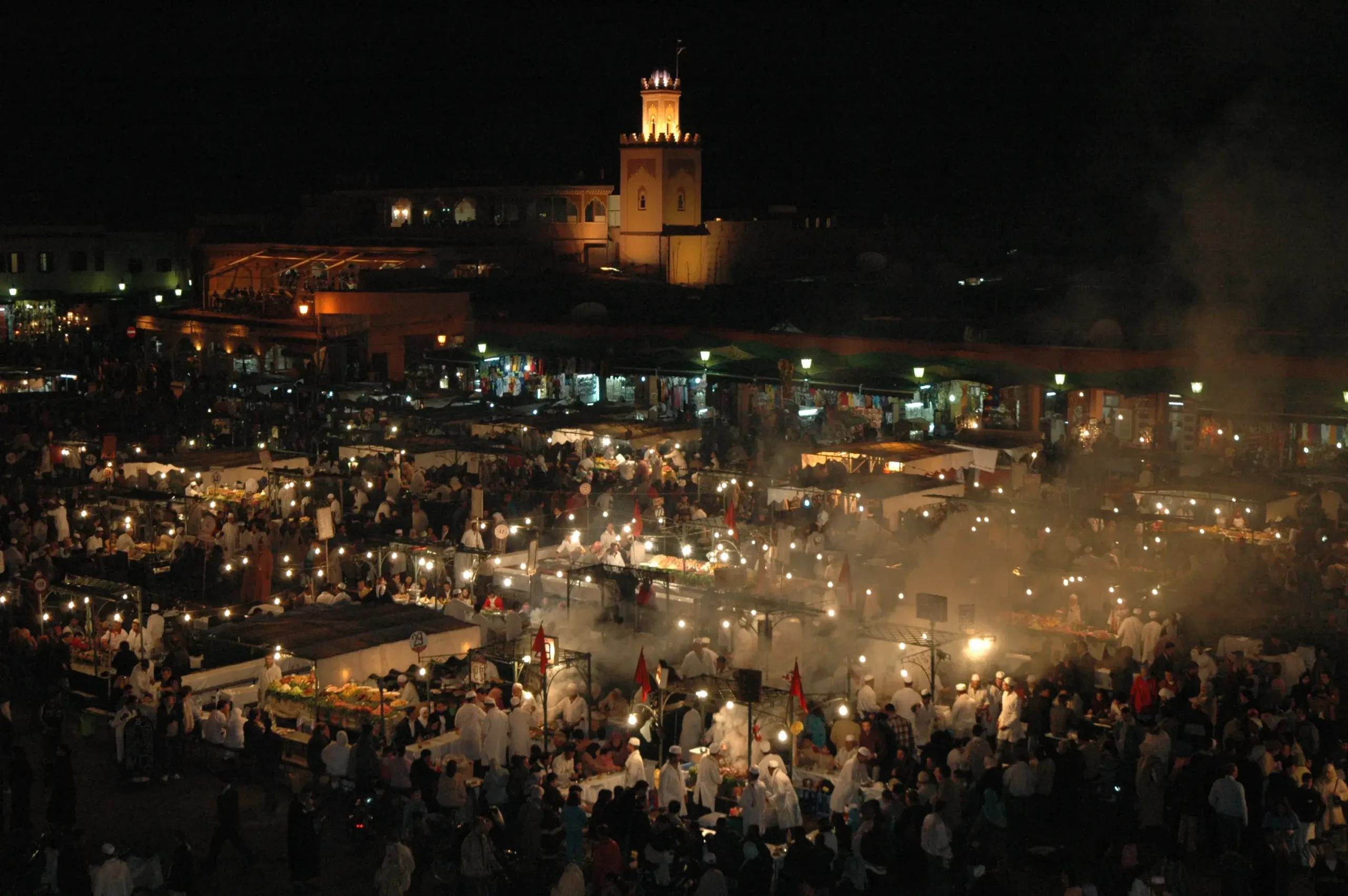
The Square at Dusk
You meet your guide at the edge of Jemaa el-Fna as the square shifts from afternoon chaos to evening spectacle. The orange juice vendors line up, the Gnaoua musicians start, and the food stall smoke begins to rise. Your guide uses this moment to orient you — what you’re looking at, why it matters, and what the night ahead holds.
This is not a rushed start. You stand here long enough to feel the rhythm of the place before the tour moves you into the city’s quieter lanes.
Into the Mellah: Olives, Dried Fruits and the Art of the Stall
From the square, you head east into the Mellah, Marrakech’s historic Jewish quarter, where the market stalls run thick with produce. Your first tasting stop is here — cone-wrapped olives in a dozen varieties, preserved lemons, dried figs, and almonds. Your guide explains how these flavors underpin Moroccan cooking and what to look for when shopping at a market stall.
This stretch of the walk is also one of the most visually alive parts of the medina at night — piled produce, lantern light, and vendors in full negotiation mode.
The Hidden Stops Most Visitors Miss
The bulk of the walk moves through lanes that most visitors never find: the neighbourhood bakehouse where sfenj (fresh Moroccan donuts) are fried to order; the harira counter where a bowl of the spiced lentil and chickpea soup costs almost nothing and tastes like nothing you get in a restaurant; the snail vendor whose clay pot of broth has been simmering with thirty-five spices since morning. Your guide points out which stalls draw locals and which ones perform for tourists — the difference matters.
The spice market at Rahba Kedima sits along the route. You stop briefly to walk through the open-air stalls, smell the ras el hanout blends, and hear your guide explain what actually goes into a tagine spice mix versus what gets sold to visitors who don’t know the difference.
Mechoui Alley and the Tangia Moment
Mechoui Alley sits just north of the square on Derb Semmarine, where family-run shops have been roasting whole lambs in clay pit ovens for generations. You stop here for a tasting portion — slow-cooked, pulled apart by hand, eaten with cumin salt and fresh bread. This is one of the most distinctly Marrakchi things you can eat anywhere.
Alongside it, your guide introduces the tangia: a sealed clay pot of slow-braised beef or lamb, traditionally cooked underground in the embers of a local hammam furnace. This dish belongs to Marrakech in a way no other city can claim. You taste it here, briefly, as your guide tells you how it’s made and where the furnace tradition comes from.
Finishing in a Riad Courtyard
The evening closes in a riad courtyard where the walls are tiled, the light is low, and a tray of mint tea and Moroccan pastries arrives without a rush. Your guide hands you a recipe card — one dish from the walk, written down in a format you can actually cook at home. The conversation winds down however it wants to.
You leave full, well-oriented, and with a clearer sense of what Marrakech tastes like when nobody is trying to impress you.
This is the plan
Check out the plan below to see what you’ll get up to with your local host. Feel free to personalize this offer with the host of your choice.
-
Jemaa el-Fna Square
Guided walk — You meet your guide at the edge of the square as the food stalls light up and the Gnaoua musicians start their sets. Your guide orients you to the square — its history as a UNESCO-listed gathering place, how it changes from day to night, and what the evening walk will cover. This is the breathing room before the lanes close in.
-
The Mellah Market
Tasting — A short walk east brings you into the Mellah, Marrakech’s old Jewish quarter, and its densely stocked produce market. Your first tasting stop is here: olives in a dozen varieties, preserved lemons, dried figs, almonds, and dates — each with a word from your guide on how they appear in Moroccan cooking. The stalls are loud, lit, and alive well into the night.
-
Backstreet Food Stalls
Tasting — Your guide leads you off the tourist circuit into the narrow derbs where locals eat. You stop at the neighbourhood sfenj (donut) fryer for a portion fresh from the oil, at the harira counter for a bowl of the city’s essential spiced soup, and — for the curious — at the snail vendor whose slow-simmered broth is a Marrakchi institution. Each stop comes with context, not just a plate.
-
Rahba Kedima — The Spice Market
Scenic stop — The route passes through Rahba Kedima, the open-air spice market that sits at the heart of the old souk network. Your guide walks you through the stalls, naming the key spices and explaining what actually goes into a ras el hanout blend versus the tourist mixes. No buying required — this is a sensory stop and a practical food lesson.
-
Mechoui Alley and the Tangia
Tasting — Just north of the square, Mechoui Alley’s family shops have been pit-roasting whole lambs in clay ovens for generations. You taste a portion here — pulled, salted with cumin, eaten with bread. Alongside it, your guide introduces the tangia: Marrakech’s own slow-braised clay pot dish, cooked underground in hammam embers. A brief tasting of each, with the story behind both.
-
Riad Courtyard Finish
Local moment — The walk ends in a traditional riad courtyard where the night slows down. Mint tea arrives with a tray of Moroccan pastries — msemen, chebakia, or the sesame-honeyed sellou, depending on the season. Your guide hands you a recipe card for one dish from the evening and stays as long as the conversation lasts.
Accomodations
Evening tour only — no overnight stay
Meals
Multiple food tastings throughout; mint tea and pastries at finish
Transportation
Walking only
Make it yours
Want to tweak the itinerary? Book directly & chat afterwards with your host to adjust highlights, skip stops, or make small changes to fit your preferences.
Book risk-free: Cancel within 24 hours for a full refund.
Need something special? Personalize your experience for more time, alternative locations or a completely tailored plan.
Flexible cancellation policy
Feel confident booking
Cancel within 24 hours for a full refund. Even up to 7 days before your experience, you’ll receive a refund, minus the service fee.
Change of plans?
Reschedule your experience to a date and time that works best for you.
Loved by travelers worldwide
Simple and flexible – your plans, your way.
Good to know
Everything you need to know for a smooth and enjoyable experience.
Where exactly do we meet, and how do I find my guide?
The meeting point is at Jemaa el-Fna Square — your booking confirmation will include the exact spot and a guide contact number (TO VERIFY with ops). Your guide will be there a few minutes before the tour starts. If you arrive early, the square is easy to reach on foot from most riads and hotels in the medina, or by taxi from Gueliz.
How much food is involved? Will this replace dinner?
Yes, for most guests the tour fully replaces dinner. Over the course of the walk you’ll taste six to eight dishes, including soup, roasted meat, fresh bread, pastries, and tea. The portions at each stop are generous but not overwhelming — the pace is designed so you can keep eating comfortably from start to finish. Come with a light stomach.
What's the difference between Private, Small Group, and Group?
All three formats follow the same route, visit the same stalls, and include the same tastings. The difference is size and guide ratio. The Group format joins other travelers for a shared experience — the most sociable and best-value option. Small Group keeps it to a maximum of eight people for a more personal walk with more time at each stop. Private means the guide is exclusively yours for the evening — ideal for couples, families, or anyone who wants to set the pace and ask every question that comes to mind.
Is this tour suitable for vegetarians or people with dietary restrictions?
Vegetarian guests are well catered for — harira, sfenj, olives, the spice market stop, pastries, and mint tea are all plant-based. The meat-based stops (mechoui, tangia) can be observed while your guide finds a suitable alternative nearby. Please inform us at booking so your guide is prepared. Guests with severe food allergies should be aware that all tastings take place at open-air street stalls where cross-contamination cannot be controlled.
How physically demanding is the walk, and is it suitable for older travelers?
The walk is entirely flat — the medina lanes are level cobblestone and packed earth, with no hills or staircases involved. The pace is gentle and there are frequent stops. Most guests in good general health, including older travelers, complete it comfortably. The main challenge is navigating narrow, busy alleys in the evening; your guide keeps the group together and sets the rhythm. If mobility is a concern, contact us before booking and we can advise.
What happens during Ramadan — does the tour still run?
Yes, the tour runs during Ramadan, but the rhythm is different. Food stalls open after iftar (the fast-breaking meal at sunset), which means the evening tour starts later and the square is dramatically busier than usual. The atmosphere during Ramadan nights in the medina is genuinely extraordinary — the streets fill with families and the food culture intensifies. We adjust the timing and route to reflect this. Let us know at booking if your visit falls during Ramadan and we’ll confirm the updated schedule.
Reviews from guests
Our experiences can be:
No strangers. Just you and your guide/driver
Let us tailor this for you
Our experiencesare always
Private & personalized
No strangers, just you. Fully customize your trip to your needs.
With a local expert
From historical facts to the most up-to-date health regulations.
Without the crowds
Experiences designed to take you away from the crowds towards authentic local spots.